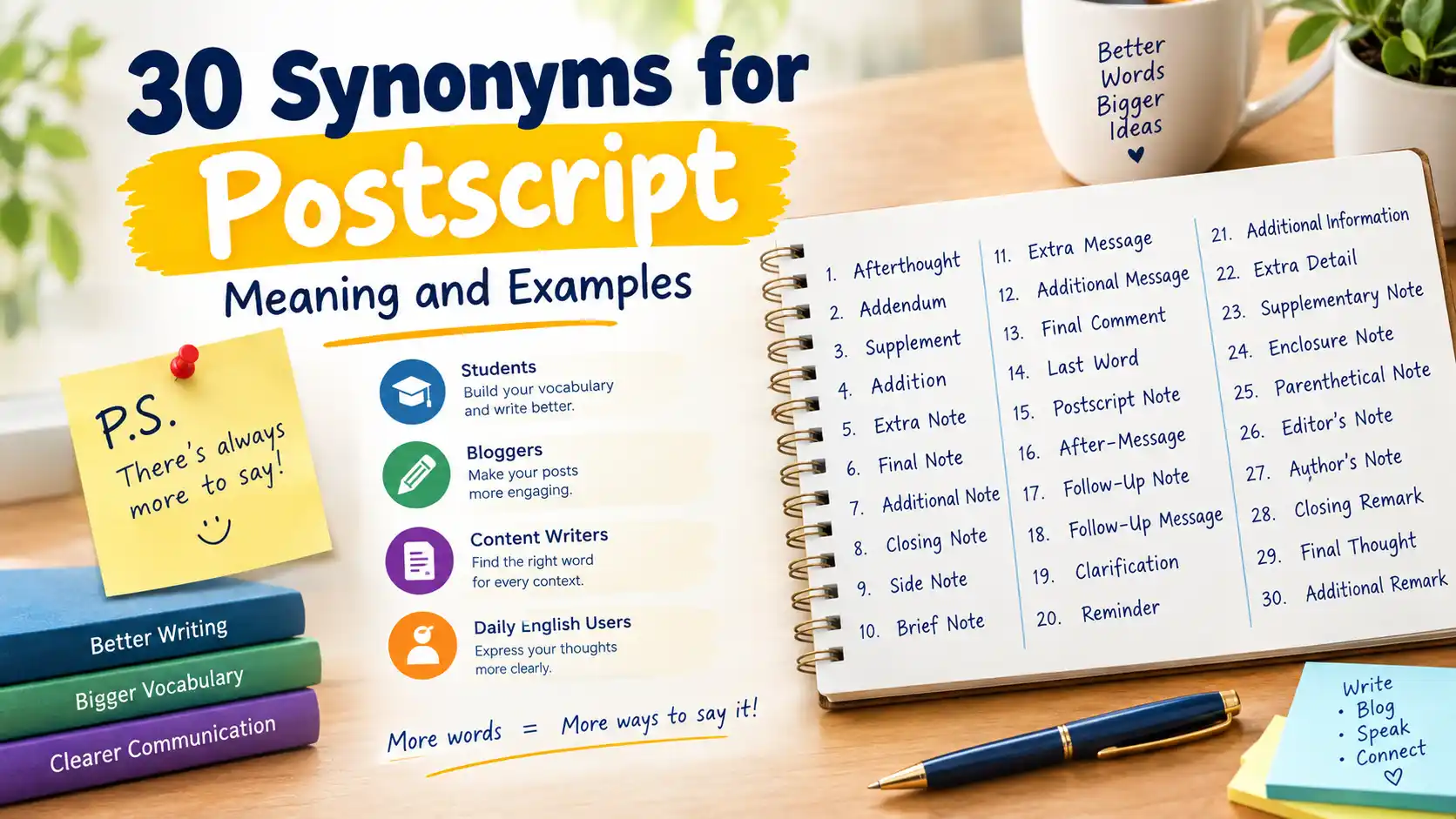
Have you ever finished a letter and then remembered something important? You may want to add one more thought without rewriting the whole message. This is where a postscript can help. A postscript is a short note added after the main message is finished. It often shares extra news, a reminder, or a final thought. For example, you might write, “P.S. Please bring your book tomorrow.” Learning synonyms for postscript can help you express extra thoughts in different ways. These words are useful for students who write essays, bloggers who create posts, content writers who prepare articles, and people who send daily messages. Some alternatives have a similar meaning, while others fit only certain situations. Knowing the difference can make your writing clearer and more natural.
1. Afterthought
Meaning: An afterthought is something you think of after you have finished your main message.
Examples:
- I added an afterthought to my letter.
- As an afterthought, she asked me to call her.
2. Addendum
Meaning: An addendum is an extra part added to a finished piece of writing.
Examples:
- The teacher added an addendum to the report.
- Please read the addendum at the end of the file.
3. Supplement
Meaning: A supplement is extra information that makes something more complete.
Examples:
- The writer added a supplement to the guide.
- This supplement gives more details about the plan.
4. Addition
Meaning: An addition is something extra that is added to something else.
Examples:
- I made one small addition to my email.
- The final addition cleared up the problem.
5. Extra Note
Meaning: An extra note is a short message added to give more information.
Examples:
- I left an extra note on your desk.
- She wrote an extra note at the end of her letter.
6. Final Note
Meaning: A final note is a last message added before a piece of writing ends.
Examples:
- My final note reminds everyone about the meeting.
- He added a final note to thank his readers.
7. Additional Note
Meaning: An additional note gives information that was not included earlier.
Examples:
- I included an additional note about the new date.
- Please check the additional note below the message.
8. Closing Note
Meaning: A closing note is a short message placed near the end of a letter or document.
Examples:
- Her closing note wished us good luck.
- I wrote a closing note before signing the letter.
9. Side Note
Meaning: A side note is a short comment that gives extra information.
Examples:
- As a side note, the shop closes at six.
- He added a side note about the cost.
10. Brief Note
Meaning: A brief note is a short message that shares a small amount of information.
Examples:
- I left a brief note for my brother.
- She added a brief note after the main text.
11. Extra Message
Meaning: An extra message is another short message sent after the main one.
Examples:
- I sent an extra message with the room number.
- His extra message explained where to park.
12. Additional Message
Meaning: An additional message gives more details after an earlier message.
Examples:
- She sent an additional message to confirm the time.
- I added an additional message about the homework.
13. Final Comment
Meaning: A final comment is a last thought shared at the end of a message or discussion.
Examples:
- My final comment was about the team’s hard work.
- He made a final comment before leaving the room.
14. Last Word
Meaning: The last word is the final thing someone says or writes about a topic.
Examples:
- She had one last word about the school trip.
- His last word thanked everyone for their help.
15. Postscript Note
Meaning: A postscript note is a short message added after the main text.
Examples:
- I added a postscript note about the gift.
- Her postscript note shared a new phone number.
16. After-Message
Meaning: An after-message is an informal message sent after the main message.
Examples:
- I sent an after-message to explain the mistake.
- His after-message included the missing details.
17. Follow-Up Note
Meaning: A follow-up note gives more information after an earlier message or event.
Examples:
- I wrote a follow-up note after our meeting.
- Her follow-up note answered my question.
18. Follow-Up Message
Meaning: A follow-up message is a later message that adds details or checks on something.
Examples:
- He sent a follow-up message the next morning.
- My follow-up message included the new address.
19. Clarification
Meaning: A clarification makes a message easier to understand.
Examples:
- I added a clarification about the payment date.
- Her clarification helped me understand the rule.
20. Reminder
Meaning: A reminder is a note that helps someone remember something important.
Examples:
- I added a reminder about tomorrow’s test.
- His reminder told us to bring our ID cards.
21. Additional Information
Meaning: Additional information gives more facts about a topic.
Examples:
- The email included additional information about the event.
- Please read the additional information at the bottom.
22. Extra Detail
Meaning: An extra detail is one more piece of information about something.
Examples:
- I added an extra detail about the trip.
- One extra detail made the story more clear.
23. Supplementary Note
Meaning: A supplementary note adds useful facts to the main text.
Examples:
- The author included a supplementary note in the guide.
- Read the supplementary note before you start.
24. Enclosure Note
Meaning: An enclosure note tells the reader about a document or item sent with a letter.
Examples:
- The enclosure note listed the papers inside the envelope.
- I added an enclosure note to explain the attached form.
25. Parenthetical Note
Meaning: A parenthetical note is extra information placed apart from the main sentence, often inside brackets.
Examples:
- I added a parenthetical note about the date.
- The parenthetical note gave the reader more context.
26. Editor’s Note
Meaning: An editor’s note is a short message from an editor that explains or adds information.
Examples:
- The editor’s note corrected a name in the article.
- An editor’s note explained why the story had changed.
27. Author’s Note
Meaning: An author’s note is a message from the writer that shares extra information with readers.
Examples:
- The author’s note thanked everyone who helped.
- I read the author’s note after the final chapter.
28. Closing Remark
Meaning: A closing remark is a final statement made before a message or talk ends.
Examples:
- Her closing remark thanked the whole team.
- He added a closing remark about working together.
29. Final Thought
Meaning: A final thought is one last idea shared before the writing ends.
Examples:
- My final thought was about the value of kindness.
- She shared a final thought at the end of her blog.
30. Additional Remark
Meaning: An additional remark is an extra comment added to the main message.
Examples:
- He made an additional remark about the new plan.
- I added an additional remark at the end of my letter.
Conclusion
Learning synonyms for postscript can help you share extra thoughts in clear and interesting ways. Words like afterthought, addendum, and final note can make your writing more useful. Some alternatives work better in letters, while others fit reports, emails, and blog posts. Try using these words in your emails, essays, and daily conversations. With regular practice, you can build your vocabulary, improve your writing, and share your ideas with greater confidence.

Hi, I’m Ahmad Khan, the founder and writer behind Article VistaZ. I created this website to share useful, engaging, and easy-to-understand articles covering a variety of topics that inform, inspire, and help readers in their everyday lives.
My goal is to provide readers with valuable content that is practical, trustworthy, and enjoyable to read. At Article VistaZ, I focus on researching topics carefully and presenting information in a simple and reader-friendly way.
Whether you are looking for helpful tips, informative articles, inspiring ideas, or answers to everyday questions, I hope Article VistaZ becomes a place you can rely on.
Thank you for visiting Article VistaZ and being part of the journey.
Ahmad Khan
Founder & Writer, Article VistaZ