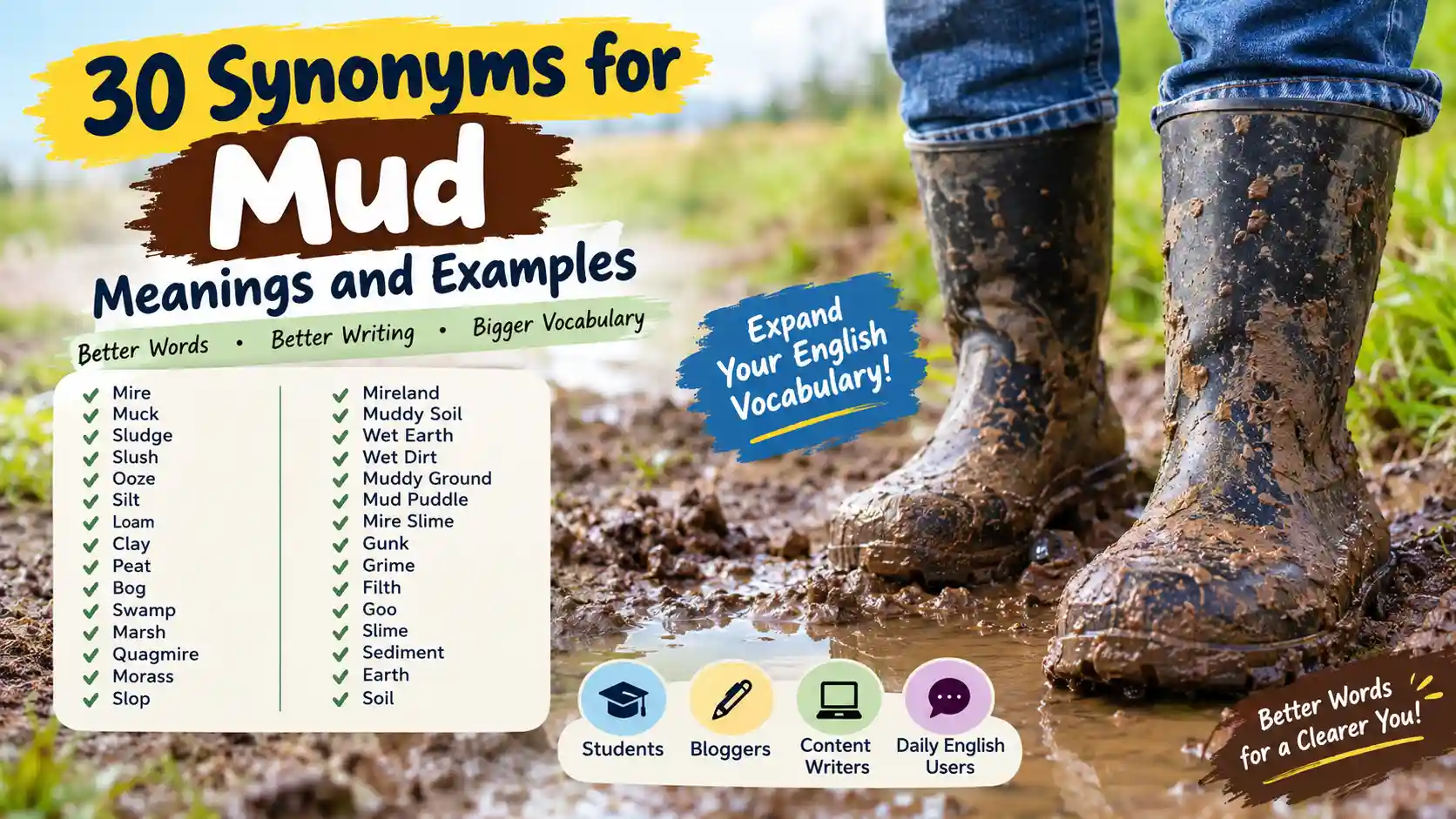
Have you ever walked outside after heavy rain and found your shoes covered in wet dirt? That sticky mess is called mud! It is common in gardens, parks, fields, and on country roads. But did you know there are many other words you can use to describe it?
Learning synonyms for mud can help you make your writing more clear and fun. Mud means wet, soft earth that sticks to things. Some words describe mud that is thick and sticky. Others describe wet ground or a mix of dirt and water.
These words are useful for students, bloggers, content writers, and anyone who wants to improve their English. They can help you write better stories, describe nature, and speak with more confidence. In this guide, you will learn 30 synonyms for mud, along with simple meanings and real-life examples.
1. Mire
Meaning: A mire is a wet, muddy area where it is hard to walk.
Examples:
- We got stuck in the mire near the lake.
- The hikers walked slowly through the mire.
2. Muck
Meaning: Muck is wet, dirty material that can be hard to clean.
Examples:
- The dog came home covered in muck.
- Dad cleaned the muck off his boots.
3. Sludge
Meaning: Sludge is thick, wet dirt or waste that moves slowly.
Examples:
- The workers removed sludge from the drain.
- Thick sludge covered the bottom of the pond.
4. Slush
Meaning: Slush is a wet mix of snow, ice, and water.
Examples:
- The children splashed through the slush.
- Dirty slush covered the road after the snow melted.
5. Ooze
Meaning: Ooze is thick, wet material that slowly flows or spreads.
Examples:
- Dark ooze came out of the wet ground.
- The old pipe leaked ooze into the ditch.
6. Silt
Meaning: Silt is very fine dirt that settles in water.
Examples:
- Silt covered the riverbank after the flood.
- The farmer found silt near the edge of the field.
7. Loam
Meaning: Loam is rich soil made from sand, clay, and other small bits of earth.
Examples:
- The gardener planted roses in soft loam.
- Loam helps many plants grow well.
8. Clay
Meaning: Clay is fine earth that becomes sticky when wet.
Examples:
- The wet clay stuck to my shoes.
- We used clay to make small pots.
9. Peat
Meaning: Peat is dark, partly decayed plant matter found in wet ground.
Examples:
- The gardener added peat to the soil.
- Peat formed over many years in the bog.
10. Bog
Meaning: A bog is a wet area with soft ground and decaying plants.
Examples:
- We saw frogs near the edge of the bog.
- The path through the bog was soft and wet.
11. Swamp
Meaning: A swamp is a wet area of land with trees or other plants.
Examples:
- Birds rested in the swamp.
- The explorers moved carefully through the swamp.
12. Marsh
Meaning: A marsh is wet land that often has grass and other small plants.
Examples:
- Tall grass grew across the marsh.
- We watched ducks swim beside the marsh.
13. Quagmire
Meaning: A quagmire is a soft, wet place where people can sink into the ground.
Examples:
- The horse stepped into a quagmire.
- The hikers avoided the quagmire near the trail.
14. Morass
Meaning: A morass is a muddy, wet area that is hard to cross.
Examples:
- The team struggled to cross the morass.
- Heavy rain turned the path into a morass.
15. Slop
Meaning: Slop is a wet, messy mix of food, dirt, or other material.
Examples:
- The pigs ate the slop from their bowls.
- Rain turned the yard into a mess of slop.
16. Mireland
Meaning: Mireland is land that is very wet and muddy.
Examples:
- Rare plants grew across the moorland.
- The map showed a wide area of moorland.
17. Muddy Soil
Meaning: Muddy soil is earth mixed with enough water to make it wet and sticky.
Examples:
- The seeds fell into the muddy soil.
- We walked across the muddy soil after the storm.
18. Wet Earth
Meaning: Wet earth is soil that has become damp or soaked with water.
Examples:
- The smell of wet earth filled the garden.
- Her boots left marks on the wet earth.
19. Wet Dirt
Meaning: Wet dirt is loose earth mixed with water.
Examples:
- Wet dirt splashed onto the car.
- The children used wet dirt to build a small hill.
20. Muddy Ground
Meaning: Muddy ground is land covered with wet, soft earth.
Examples:
- The players slipped on the muddy ground.
- We placed wooden boards over the muddy ground.
21. Mud Puddle
Meaning: A mud puddle is a small pool of muddy water on the ground.
Examples:
- The little boy jumped into a mud puddle.
- A mud puddle formed beside the gate.
22. Mire Slime
Meaning: Mire slime is a slippery, wet layer found in some muddy places.
Examples:
- Green mire slime covered the old stones.
- The boots slid over the mire slime.
23. Gunk
Meaning: Gunk is a sticky, dirty substance that collects on things.
Examples:
- I wiped the gunk off the garden tools.
- Thick gunk blocked the kitchen drain.
24. Grime
Meaning: Grime is a layer of dirt that makes something look dirty.
Examples:
- Grime covered the bottom of his shoes.
- She scrubbed the grime off the garden table.
25. Filth
Meaning: Filth is very dirty or unpleasant material.
Examples:
- The old shed was full of filth.
- They cleaned the filth from the flooded room.
26. Goo
Meaning: Goo is a thick, sticky substance that is often messy.
Examples:
- The children made green goo for a science project.
- A strange brown goo covered the rock.
27. Slime
Meaning: Slime is a slippery, thick substance that is often wet.
Examples:
- Slime covered the rocks beside the pond.
- The toy was filled with stretchy slime.
28. Sediment
Meaning: Sediment is small pieces of dirt or other material that settle at the bottom of water.
Examples:
- Sediment collected at the bottom of the jar.
- The river left sediment along the shore.
29. Earth
Meaning: Earth is the soil or ground found on land.
Examples:
- She brushed the earth from her hands.
- The rain softened the earth around the tree.
30. Soil
Meaning: Soil is the top layer of earth where many plants grow.
Examples:
- The farmer tested the soil before planting.
- Rain soaked the soil in the flower bed.
Conclusion
Learning synonyms for mud helps you describe wet ground, dirt, and sticky substances in more detail. These words can make your writing, blogging, speaking, and daily communication better. Remember that not every synonym has the same meaning, so choose the word that fits your sentence. Practice using these words in emails, essays, stories, and daily conversations. With regular practice, you will build your vocabulary and express your ideas more clearly.

Hi, I’m Ahmad Khan, the founder and writer behind Article VistaZ. I created this website to share useful, engaging, and easy-to-understand articles covering a variety of topics that inform, inspire, and help readers in their everyday lives.
My goal is to provide readers with valuable content that is practical, trustworthy, and enjoyable to read. At Article VistaZ, I focus on researching topics carefully and presenting information in a simple and reader-friendly way.
Whether you are looking for helpful tips, informative articles, inspiring ideas, or answers to everyday questions, I hope Article VistaZ becomes a place you can rely on.
Thank you for visiting Article VistaZ and being part of the journey.
Ahmad Khan
Founder & Writer, Article VistaZ