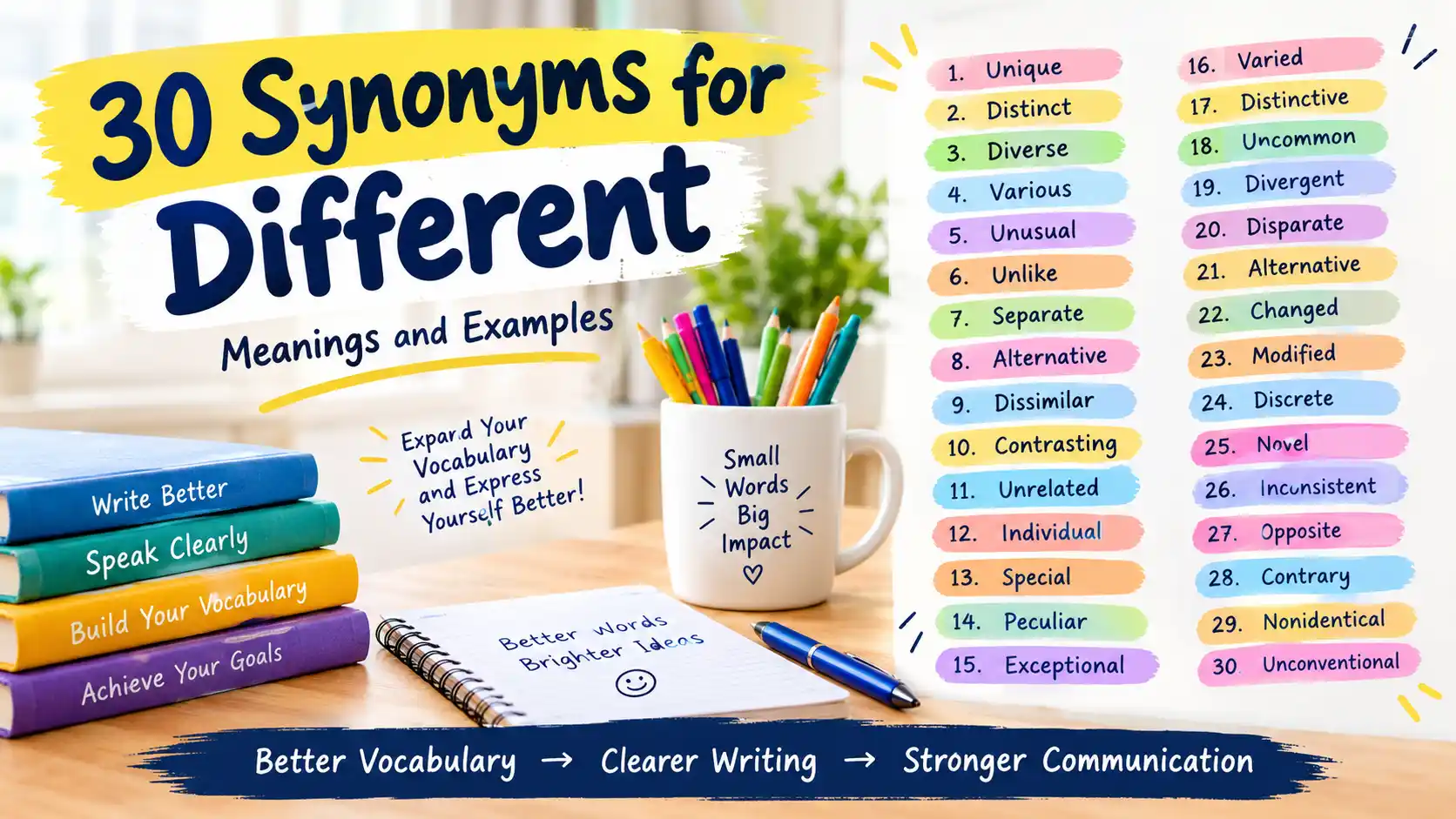
Have you ever used the word “different” many times in the same paragraph? Learning synonyms can help you make your writing more clear and fun. There are many synonyms for differences that you can use in daily life. For example, you can say, “My shoes are different,” or “My shoes are unique.” Both sentences show that the shoes are not the same as others.
The word “different” means not the same as something or someone else. It is useful for students who write essays, bloggers who create posts, content writers who want fresh words, and people who speak English every day. Learning synonyms for different things helps you share your ideas in better ways. It also makes your sentences more interesting and helps you grow your English vocabulary.
1. Unique
Meaning: Something unique is special and not like anything else.
Examples:
- She has a unique style of painting.
- This shop sells unique gifts.
2. Distinct
Meaning: Something distinct is easy to tell apart from other things.
Examples:
- The twins have distinct voices.
- I saw two distinct colors on the wall.
3. Diverse
Meaning: Diverse things are made up of many different types.
Examples:
- Our school has a diverse group of students.
- The park is home to diverse birds and plants.
4. Various
Meaning: Various means several different kinds of things.
Examples:
- We tried various ways to solve the problem.
- The store sells various types of bread.
5. Unusual
Meaning: Something unusual is not common or normal.
Examples:
- He wore an unusual hat to the party.
- It is unusual to see snow here in April.
6. Unlike
Meaning: Unlike means not similar to someone or something.
Examples:
- Unlike his brother, Ali enjoys reading.
- This summer feels unlike any other.
7. Separate
Meaning: Separate things are apart and not joined together.
Examples:
- Please put the clean clothes in separate bags.
- We have separate rooms in our house.
8. Alternative
Meaning: An alternative is another choice you can use.
Examples:
- We need an alternative plan for rainy days.
- You can choose an alternative route to school.
9. Dissimilar
Meaning: Dissimilar things are not alike.
Examples:
- Their ideas are dissimilar in many ways.
- These two bags look dissimilar to me.
10. Contrasting
Meaning: Contrasting things are very different from each other.
Examples:
- She wore a black shirt with contrasting white stripes.
- The room has contrasting shades of blue and yellow.
11. Unrelated
Meaning: Unrelated things have no clear link to each other.
Examples:
- His comment was unrelated to our discussion.
- These two stories are completely unrelated.
12. Individual
Meaning: Individual means one person or thing considered on its own.
Examples:
- Each student has an individual locker.
- We spoke to each individual team member.
13. Special
Meaning: Something special is not ordinary and may have extra value.
Examples:
- My grandmother made a special cake for me.
- Today is a special day for our family.
14. Peculiar
Meaning: Something peculiar is strange or not usual.
Examples:
- There was a peculiar smell in the kitchen.
- He made a peculiar sound during the game.
15. Exceptional
Meaning: Something exceptional is much better or different from what is usual.
Examples:
- She showed exceptional skill on the piano.
- The team did an exceptional job this season.
16. Varied
Meaning: Varied means having many different types or forms.
Examples:
- We enjoy a varied diet at home.
- The teacher uses varied activities in class.
17. Distinctive
Meaning: Something distinctive has a special feature that makes it easy to recognize.
Examples:
- The bird has a distinctive red head.
- Her voice is soft but distinctive.
18. Uncommon
Meaning: Something uncommon does not happen or appear often.
Examples:
- It is uncommon to find this flower in winter.
- He has an uncommon talent for solving puzzles.
19. Divergent
Meaning: Divergent ideas or paths move in different directions.
Examples:
- The two friends had divergent views on the issue.
- Our plans became divergent after the meeting.
20. Disparate
Meaning: Disparate things are very different in type or nature.
Examples:
- The report brings together disparate ideas.
- The team includes people with disparate skills.
21. Alternative
Meaning: Alternative describes another option that can replace the first one.
Examples:
- We found an alternative source of energy.
- The doctor suggested an alternative treatment.
22. Changed
Meaning: Changed means made different from how something was before.
Examples:
- My plans changed after the phone call.
- The town has changed a lot over the years.
23. Modified
Meaning: Modified means changed a little to improve or suit something.
Examples:
- We used a modified recipe for the cake.
- The teacher gave us a modified test.
24. Discrete
Meaning: Discrete things are separate and distinct from one another.
Examples:
- The course has five discrete sections.
- We studied discrete groups of numbers in class.
25. Novel
Meaning: Something novel is new or different from what people know.
Examples:
- The team came up with a novel idea.
- She tried a novel way to teach the lesson.
26. Inconsistent
Meaning: Inconsistent means not staying the same in behavior, quality, or results.
Examples:
- His answers were inconsistent during the quiz.
- The internet speed is inconsistent in our area.
27. Opposite
Meaning: Opposite means completely different in direction, meaning, or nature.
Examples:
- My answer was the opposite of hers.
- The two teams have opposite playing styles.
28. Contrary
Meaning: Contrary means going against an idea or being very different from it.
Examples:
- Contrary to my guess, the test was easy.
- His actions were contrary to his promises.
29. Nonidentical
Meaning: Nonidentical means not exactly the same.
Examples:
- The twins are nonidentical and look quite different.
- These copies are nonidentical in several small details.
30. Unconventional
Meaning: Something unconventional does not follow the usual way of doing things.
Examples:
- She chose an unconventional design for her home.
- His unconventional approach helped solve the problem.
Conclusion
Learning synonyms for different things can make your writing clearer and more interesting. Words like unique, distinct, diverse, and unusual help you express ideas with greater detail. Students can use them in essays, bloggers can improve their posts, and content writers can avoid repeating the same words. Practice these synonyms in emails, schoolwork, and daily conversations. Choose the word that best fits your meaning, and your English will grow stronger with regular practice.

Hi, I’m Ahmad Khan, the founder and writer behind Article VistaZ. I created this website to share useful, engaging, and easy-to-understand articles covering a variety of topics that inform, inspire, and help readers in their everyday lives.
My goal is to provide readers with valuable content that is practical, trustworthy, and enjoyable to read. At Article VistaZ, I focus on researching topics carefully and presenting information in a simple and reader-friendly way.
Whether you are looking for helpful tips, informative articles, inspiring ideas, or answers to everyday questions, I hope Article VistaZ becomes a place you can rely on.
Thank you for visiting Article VistaZ and being part of the journey.
Ahmad Khan
Founder & Writer, Article VistaZ