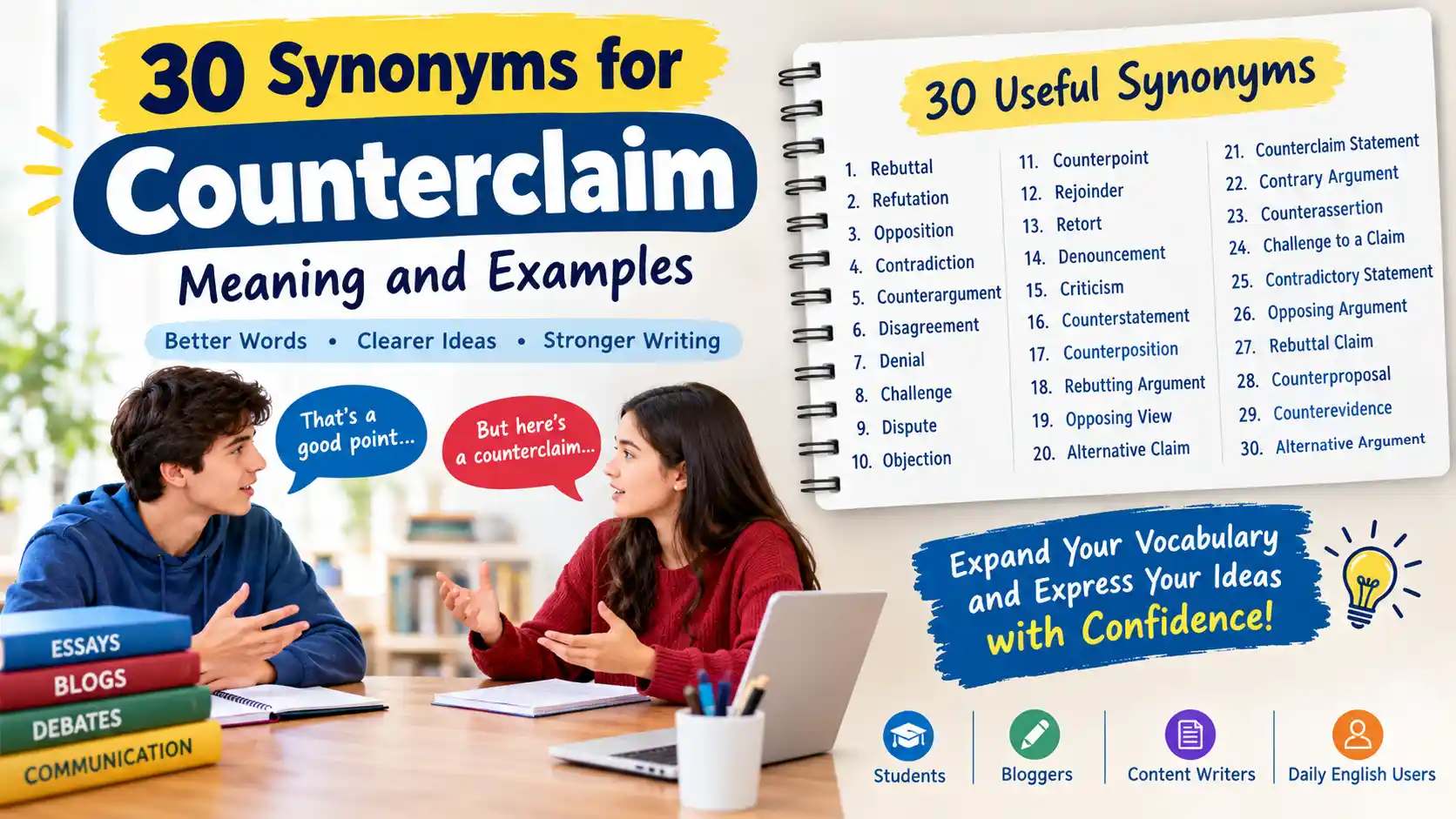
Have you ever disagreed with someone’s opinion and wanted to share a different view? You may use a counterclaim to do this. A counterclaim is a statement that goes against another person’s claim or idea. For example, one student may say that homework helps children learn. Another student may argue that too much homework causes stress. This second view is a counterclaim. Learning synonyms for counterclaim can help you express your ideas in new ways. These words are useful for students, bloggers, content writers, and daily English users. They can make your essays, debates, and conversations clearer. In this guide, you will discover 30 synonyms for counterclaim with simple meanings and easy examples.
1. Rebuttal
Meaning: A rebuttal is an answer that shows why someone else’s claim may be wrong.
Examples:
- She gave a strong rebuttal during the class debate.
- His rebuttal changed the way we saw the issue.
2. Refutation
Meaning: A refutation is a statement that proves an idea is wrong.
Examples:
- The writer gave a refutation of the false claim.
- His facts helped support the refutation.
3. Opposition
Meaning: Opposition is a view or action that goes against something.
Examples:
- The new rule faced strong opposition from parents.
- Her opposition to the plan was clear.
4. Contradiction
Meaning: A contradiction is a statement that says the opposite of another statement.
Examples:
- His answer was a contradiction of her claim.
- The report contains a clear contradiction.
5. Counterargument
Meaning: A counterargument is a reason or idea that goes against another argument.
Examples:
- The student added a counterargument to her essay.
- We discussed every counterargument before making a choice.
6. Disagreement
Meaning: A disagreement is a difference between two people’s views.
Examples:
- Their disagreement started during the meeting.
- We had a small disagreement about the school project.
7. Denial
Meaning: A denial is a statement that says something is not true.
Examples:
- His denial surprised everyone in the room.
- The company made a denial of the news report.
8. Challenge
Meaning: A challenge is an act of questioning or going against an idea.
Examples:
- She made a challenge to his main point.
- The new study was a challenge to old beliefs.
9. Dispute
Meaning: A dispute is a disagreement about a fact, idea, or issue.
Examples:
- The two teams had a dispute over the final score.
- His statement caused a dispute among the workers.
10. Objection
Meaning: An objection is a reason for not agreeing with something.
Examples:
- She raised an objection during the class discussion.
- His main objection was the high cost.
11. Counterpoint
Meaning: A counterpoint is an idea that shows another side of an argument.
Examples:
- The teacher shared a counterpoint to the student’s opinion.
- Her example added a useful counterpoint to the discussion.
12. Rejoinder
Meaning: A rejoinder is a quick answer to a statement or argument.
Examples:
- He gave a clever rejoinder to her question.
- Her rejoinder made everyone laugh.
13. Retort
Meaning: A retort is a quick and often sharp reply.
Examples:
- She gave a sharp retort to his rude comment.
- His retort ended the argument.
14. Denouncement
Meaning: A denouncement is a public statement that strongly says something is wrong.
Examples:
- The leader made a denouncement of the unfair law.
- Her denunciation of the plan gained public support.
15. Criticism
Meaning: Criticism is an opinion that points out what is wrong with something.
Examples:
- The article received criticism from many readers.
- He offered criticism of the new school policy.
16. Counterstatement
Meaning: A counterstatement is a statement that gives an opposite view.
Examples:
- The lawyer prepared a counterstatement for the case.
- Her counterstatement gave another side of the story.
17. Counterposition
Meaning: A counterposition is a view that stands against another person’s position.
Examples:
- The speaker explained his counterposition during the debate.
- Their counterposition made the discussion more interesting.
18. Rebutting Argument
Meaning: A rebutting argument is a reason used to answer and weaken another claim.
Examples:
- She added a rebutting argument to her essay.
- His rebutting argument was based on real facts.
19. Opposing View
Meaning: An opposing view is an opinion that is different from another opinion.
Examples:
- The article explains both sides, including the opposing view.
- We should listen to an opposing view before deciding.
20. Alternative Claim
Meaning: An alternative claim is a different statement that offers another idea.
Examples:
- The researcher presented an alternative claim.
- Her alternative claim gave readers a new way to think.
21. Counterclaim Statement
Meaning: A counterclaim statement is a sentence that presents an idea against another claim.
Examples:
- Write a counterclaim statement in the second paragraph.
- His counterclaim statement made the essay stronger.
22. Contrary Argument
Meaning: A contrary argument is a reason that supports the opposite side.
Examples:
- The student used a contrary argument in her speech.
- A contrary argument can help readers see both sides.
23. Counterassertion
Meaning: A counterassertion is a statement that goes against a claim made by someone else.
Examples:
- The lawyer presented a counterassertion in court.
- His counterassertion questioned the main point of the report.
24. Challenge to a Claim
Meaning: A challenge to a claim is an attempt to question whether an idea is true.
Examples:
- The new evidence was a challenge to the claim.
- She made a challenge to his claim about the results.
25. Contradictory Statement
Meaning: A contradictory statement is a statement that does not agree with another one.
Examples:
- His contradictory statement confused the class.
- The witness made a contradictory statement during the interview.
26. Opposing Argument
Meaning: An opposing argument is a reason that supports a different side of an issue.
Examples:
- The writer included an opposing argument in the article.
- We heard an opposing argument before the final vote.
27. Rebuttal Claim
Meaning: A rebuttal claim is a statement that answers and questions another claim.
Examples:
- The student added a rebuttal claim to her essay.
- His rebuttal claim focused on the missing facts.
28. Counterproposal
Meaning: A counterproposal is a different offer made in response to another offer.
Examples:
- The workers presented a counterproposal to the company.
- Her counterproposal included a lower price.
29. Counterevidence
Meaning: Counterevidence is information that goes against a claim or idea.
Examples:
- The scientist found counterevidence to the old theory.
- The lawyer used counterevidence to question the story.
30. Alternative Argument
Meaning: An alternative argument is another reason or idea that supports a different side.
Examples:
- The student shared an alternative argument in class.
- His alternative argument helped us understand the problem.
Conclusion
Learning synonyms for counterclaim can make your writing and speaking stronger. These words help you share different opinions, explain your ideas, and take part in discussions. They are useful for essays, blogs, debates, and everyday conversations. Try using these words in your emails, school assignments, and daily talks. With regular practice, you can build better vocabulary and express your thoughts with confidence.

Hi, I’m Ahmad Khan, the founder and writer behind Article VistaZ. I created this website to share useful, engaging, and easy-to-understand articles covering a variety of topics that inform, inspire, and help readers in their everyday lives.
My goal is to provide readers with valuable content that is practical, trustworthy, and enjoyable to read. At Article VistaZ, I focus on researching topics carefully and presenting information in a simple and reader-friendly way.
Whether you are looking for helpful tips, informative articles, inspiring ideas, or answers to everyday questions, I hope Article VistaZ becomes a place you can rely on.
Thank you for visiting Article VistaZ and being part of the journey.
Ahmad Khan
Founder & Writer, Article VistaZ